JOIN Operator
JOIN is used to combine related tuples from two relations:- In its simplest form the JOIN operator is just the cross product of the two relations.
- As the join becomes more complex, tuples are removed within the cross product to make the result of the join more meaningful.
- JOIN allows you to evaluate a join condition between the attributes of the relations on which the join is undertaken.
R JOINjoin condition S
JOIN Example
-
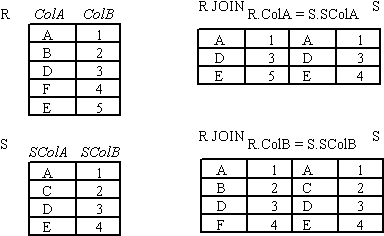
- Figure : JOIN
Natural Join
Invariably the JOIN involves an equality test, and thus is often described as an equi-join. Such joins result in two attributes in the resulting relation having exactly the same value. A `natural join' will remove the duplicate attribute(s).- In most systems a natural join will require that the attributes have the same name to identify the attribute(s) to be used in the join. This may require a renaming mechanism.
- If you do use natural joins make sure that the relations do not have two attributes with the same name by accident.
OUTER JOINs
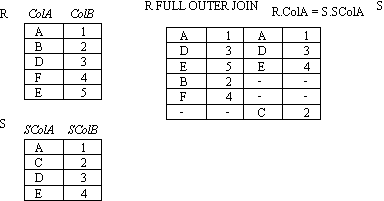
Notice that much of the data is lost when applying a join to two relations. In some cases this lost data might hold useful information. An outer join retains the information that would have been lost from the tables, replacing missing data with nulls.There are three forms of the outer join, depending on which data is to be kept.
- LEFT OUTER JOIN - keep data from the left-hand table
- RIGHT OUTER JOIN - keep data from the right-hand table
- FULL OUTER JOIN - keep data from both tables
OUTER JOIN example 1
-
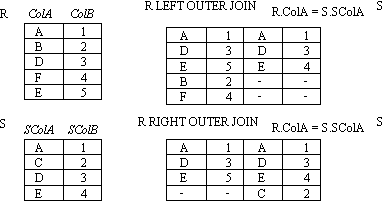
- Figure : OUTER JOIN (left/right)